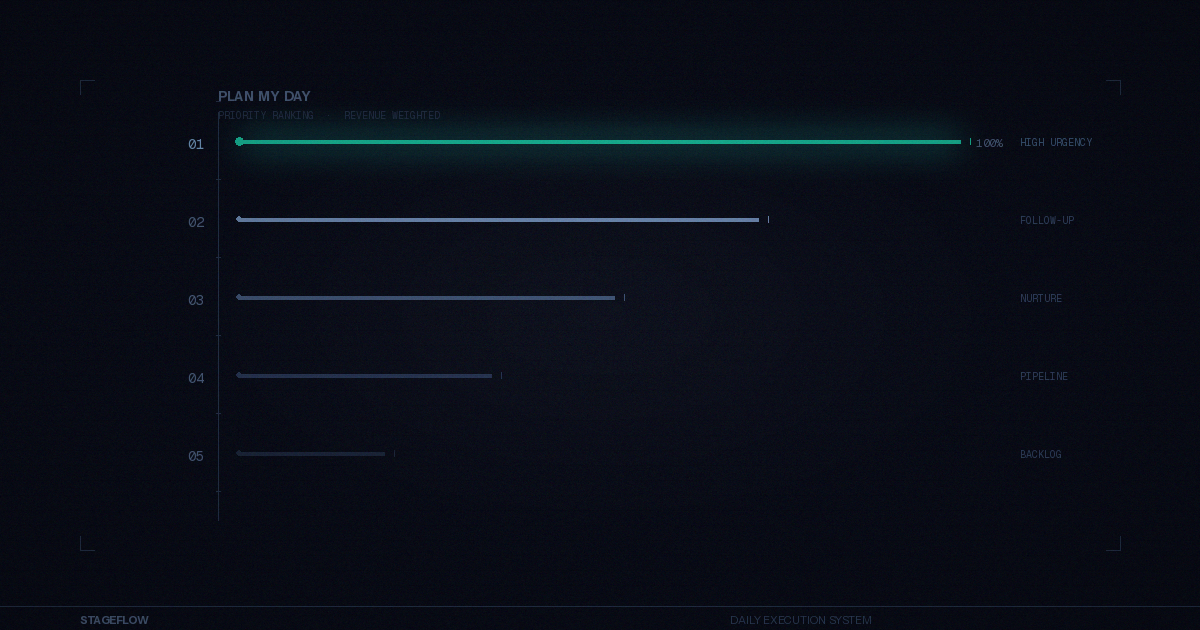
High-growth SMB revenue teams should prioritize daily sales activities by revenue impact and time sensitivity, derived from live pipeline data — not from memory, habit, or the most recent email. The most effective daily priority structure for a team of 2–20 sellers: first, any deal with a close date in the next seven days that has no confirmed next step; second, any deal that has gone more than four business days without logged activity; third, inbound leads (contact rate drops more than 80% after the first hour); fourth, advancing late-stage deals with next steps due this week. This priority structure should be generated from pipeline data automatically, not reconstructed by each rep every morning.
Add up what happens in the first 60 minutes of most SMB revenue teams' selling day: reps open the CRM, scan the pipeline, try to remember which deals they worked last, mentally rank who to call first, check email, get pulled into Slack, and start the day without a clear first action.
By the time actual selling starts, it is often 10:00 or 10:30.
For a team of five sellers, that is five hours of selling time lost before the day begins — every day. Over a quarter, it compounds into weeks of lost capacity.
Research consistently shows that sales professionals spend less than 30% of their time on actual selling activity. (Source: Salesforce State of Sales) For scaling SMB teams without dedicated sales ops support, that fraction is often lower. The time that should be selling becomes planning, organizing, and rediscovering context.
The fix is not a longer meeting or a more detailed CRM. It is a system that generates a ranked action list from pipeline data automatically — so the team starts executing, not deciding.
Most revenue leaders tell their teams to "check the pipeline" at the start of each day. The problem is structural: a standard CRM view shows every open deal in every stage, sorted by last modified date or stage name.
It does not tell a rep which deal is most at risk of going cold today. It does not surface the follow-up that was due yesterday. It does not rank opportunities by revenue impact relative to close-date urgency. It does not tell the team lead which deals need attention before the week is out.
All of that prioritization happens manually, in each rep's head, every morning — with no consistency, no calibration to actual revenue pacing, and no mechanism to catch the deals slipping through the gaps.
At two or three reps, this is manageable through sheer attention and memory. At five to fifteen reps, it becomes the primary source of revenue leakage. The deals that get attention are the ones reps remember, not the ones that matter most.
Before a single call is made or email sent, the daily plan for a high-growth revenue team should already have answered three questions:
1. Which deals are most at risk of closing lost if no one acts today?
These are deals with close dates in the next seven to fourteen days and no recent logged activity or next step. They are the highest-priority contacts because the window to advance or recover them is actively closing. At a team level, these should be surfaced to both the rep and the manager — not discovered in a Friday pipeline review.
2. Which opportunities have the highest revenue impact relative to where they sit in the cycle?
Not every open deal deserves equal attention. A deal at 75% probability with a close date in five days outranks a deal at 20% probability regardless of which one the rep had a better conversation with last. Revenue-weighted prioritization is what separates teams that close on time from teams that are always chasing.
3. Which deals in the pipeline have no next step scheduled?
A deal with no confirmed next step is not advancing — it is floating. Every active opportunity should have a specific next action tied to a specific date. At the team level, the total number of deals without a next step is a leading indicator of pipeline health. If that number is rising, revenue risk is accumulating before it shows up in the forecast.
Effective daily prioritization for a five-to-fifteen person revenue team requires four things operating together:
Live, shared pipeline data. A daily plan built on data that is twelve hours stale is potentially worse than no plan, because it creates false confidence. Every rep's view and every manager's view needs to reflect the same current state.
Computed risk signals per deal. Without a risk signal that updates automatically, prioritization defaults to whichever deal the rep has most recently spoken about. Recency bias is the enemy of revenue-weighted prioritization. Time in stage, activity recency, and close-date integrity converted into a score per deal removes the subjective layer.
Revenue pacing context. Whether the team is ahead or behind the monthly target should change how deals are prioritized. Behind pace with ten days left means late-stage deals with real buying signals get all available capacity. Ahead of pace creates room to invest in pipeline development. A daily plan without pacing context is disconnected from the number that actually matters.
One shared view, not five individual ones. The most common failure point in SMB revenue prioritization is fragmentation — each rep has their own view, the manager has a different view, and nobody is working from the same picture. A single ranked view, consistent across the team, is what makes the daily plan a coordination tool rather than a personal to-do list.
This is the structure that high-performing SMB revenue teams use to keep daily execution sharp without a full-time RevOps function:
8:30 — Team lead reviews the day's priority list (10 minutes)
Before the team is selling, the revenue leader scans the ranked opportunity list: which deals need attention today, which reps own them, and whether the coverage picture for the current period looks healthy. Flags anything that needs a coaching conversation or a deal rescue.
9:00 — Reps execute against their priority list (90–120 minutes of focused selling)
First block is for the highest-priority contacts: at-risk deals, overdue follow-ups, inbound leads that came in overnight. The priority list is already built. Reps do not decide what to work on — they execute the plan.
End of day — 10-minute close-out loop
Every deal touched that day gets a next step logged and a close date confirmed. Any deal with a close date that passed without closing gets moved to the appropriate status. This is the step that makes tomorrow's priority list accurate. Skip it and the plan degrades within 48 hours.
The discipline gap for most SMB teams is almost always in that end-of-day loop. When next steps do not get logged, tomorrow's plan is built on incomplete data — and the compounding error grows across the week.
Revenue leaders at scaling SMBs face a version of this problem that is structurally different from what an individual rep faces:
Visibility without context. A manager can see the pipeline, but without deal-level risk signals and pacing data, the pipeline view does not tell them where the actual problems are until it is too late.
Coordination at scale. Five reps working from five individual priority lists is not a revenue operation — it is five solo selling efforts running in parallel. The leverage of a manager is in coordinating the team's capacity toward the highest-impact opportunities. That coordination requires shared data and shared prioritization.
Coaching versus firefighting. Revenue leaders who spend their days in reactive mode — responding to deal questions, handling objections, filling in gaps — are not coaching. Proactive visibility into which deals are drifting allows a manager to intervene with coaching at the moment it is most effective: before the deal is lost, not after.
A daily execution system that works at the team level solves all three of these. It surfaces the right information to the right person at the right time — without requiring anyone to manually compile it.
StageFlow's Plan My Day generates a ranked action list from live pipeline data every day for each member of the revenue team. It does not require reps to sort through their pipeline manually, remember which deals they worked last week, or cross-reference a spreadsheet. The prioritization is done from the data.
The Today Plan Panel groups and ranks deals by run-rate status — so if the team is behind the monthly target, the deals with the highest revenue impact relative to urgency surface first. The plan is calibrated to where the team actually stands, not to an arbitrary activity quota.
The RISQ Score per deal gives the revenue leader deal-level risk signals across the full pipeline — surfacing which opportunities need attention before they go cold, with specific drivers rather than a vague red flag. The difference between "this deal has no next step and hasn't been touched in six days with a close date in eight days" and "this deal is red" is the difference between a coaching conversation and a post-mortem.
The result is a revenue team that starts selling at 9:00, not at 10:30.
Q: How is a daily revenue priority list different from a CRM task list?
A: A task list is a collection of actions someone decided to log at some point in the past. A priority list generated from live pipeline data reflects what matters most right now, based on deal risk, close-date urgency, and revenue pacing against target. The difference is whether the prioritization is manual and historical or automatic and current.
Q: At what team size does daily prioritization become a serious problem?
A: The cognitive load of tracking deal status, next steps, and urgency across every active opportunity exceeds most individuals' capacity around eight to twelve deals. For a team, the coordination problem compounds significantly once you have three or more reps — because there is no shared system for where the team's collective attention should go.
Q: How do we measure whether our daily execution system is working?
A: Three proxy metrics: average time from lead creation to first contact (should be under one business hour for inbound), percentage of open deals with a next step logged (should be above 90%), and percentage of close dates that are updated weekly versus sitting unchanged for more than seven days (should be above 80% updated). These three numbers tell you whether the execution system is holding.
Q: What's the minimum viable version of a daily execution system without any new software?
A: One shared Slack message each morning from the revenue leader: the top five deals that need team attention today, ranked by urgency. And one end-of-day rule: no rep ends the day without logging a next step on every deal they touched. Manual, but it enforces the behavior that makes a more sophisticated system worth having later.
Q: How does daily execution discipline relate to forecast accuracy?
A: Directly. A daily execution system that enforces next-step logging and close-date updates produces accurate forecast data as a byproduct. Most forecast accuracy problems are execution problems upstream — not modeling problems. Fix the daily discipline and the forecast improves without changing anything about how you build the model.
StageFlow generates a ranked daily action list from your live pipeline — for every rep and every revenue leader on the team. Built for high-growth SMBs and scaling revenue teams of 1 to 50, with flat-rate pricing and no per-seat fees. Learn more at stageflow.startupstage.com.