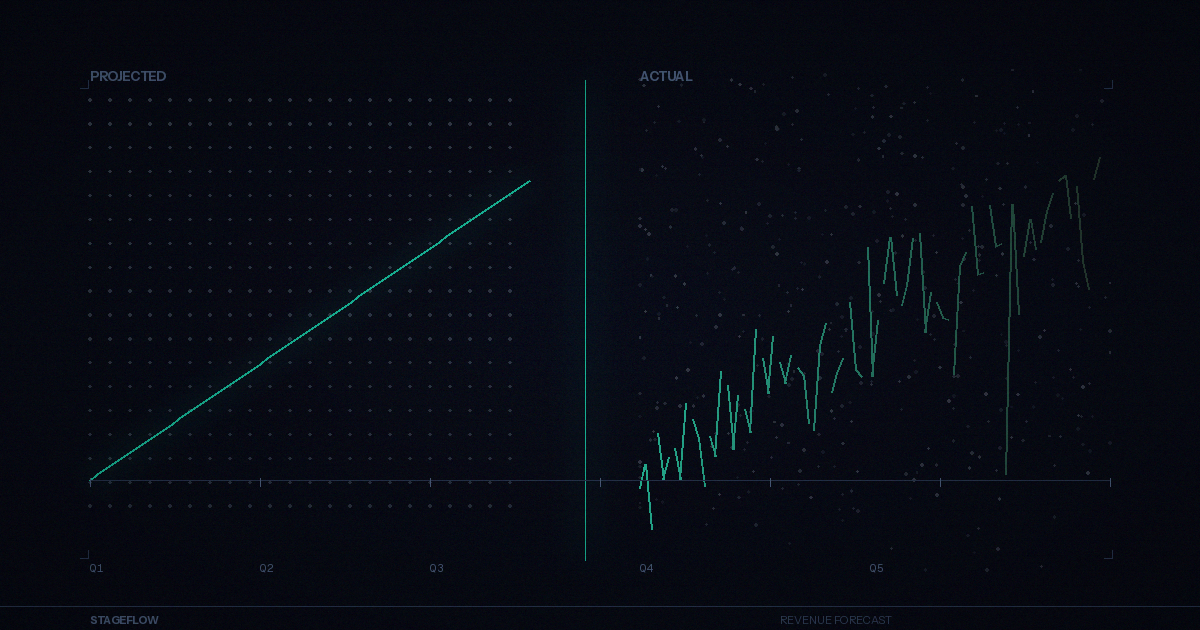
High-growth SMBs misforecast for three consistent reasons: stage probabilities that were never calibrated to actual win rates, close dates that are aspirational rather than enforced, and pipeline volume that masks conversion quality problems. The result is a forecast that looks healthy at the start of the quarter and surprises at the end. The fix is a weighted forecast calibrated to your own historical conversion data, a weekly close-date integrity discipline, and a computed risk signal per deal — not a gut-feel health rating. None of this requires a dedicated RevOps hire to implement.
The pipeline was full going into the quarter. The team was busy. The CRM showed green across the board.
And then you missed.
Not by a rounding error — by enough that it changed the conversation with your board, your investors, or yourself. And the worst part: you didn't see it coming until it was too late to course-correct.
This is the revenue forecasting failure pattern that hits high-growth SMBs between $1M and $20M ARR harder than almost any other company stage. You have enough pipeline to create false confidence, enough team activity to look productive, and not yet enough RevOps infrastructure to catch the drift before it becomes a miss.
Understanding the three root causes — and which one is costing you the most — is the fastest path to a forecast you can actually trust.
Every CRM ships with default win probabilities attached to pipeline stages. "Proposal Sent" at 50%. "Negotiation" at 80%. These numbers are industry averages derived from aggregate data — they are not your data.
If your actual close rate from "Proposal Sent" is 31%, running your forecast at 50% means you are systematically overstating expected revenue at that stage by more than 60%. Multiply that across a pipeline of twenty active deals and you can be off by hundreds of thousands of dollars before the quarter begins.
The fix is a 90-day audit: of every deal that reached each stage in the last three months, what percentage actually closed? Use those conversion rates — not the defaults. This single calibration step is the highest-return, lowest-effort improvement most SMB revenue teams can make to forecast accuracy.
Weighted pipeline forecasting assigns a close probability to each deal based on stage, and the most accurate forecasts use conversion rates derived from your own historical data rather than generic probability tables. (Source: DealHub, "The Complete Guide to Pipeline Forecasting")
At the SMB growth stage, close dates are often aspirational entries made at deal creation and never touched again. A deal that was supposed to close in February becomes March becomes "Q2 when they're ready."
The compounding problem: when close dates are decorative, your forecast by definition cannot be accurate. Every deal you are counting on for the month is potentially a deal that should have moved to the next period — or to close-lost — weeks ago.
Research from Salesforce's State of Sales found that only 28% of sales professionals expect to hit their quota, and one of the most cited contributing factors is inaccurate deal-stage management. Close-date integrity is the discipline that separates teams with predictable revenue from teams that are always surprised.
The rule that works at scale: any deal with a close date in the next 30 days must be reviewed and confirmed or updated every Monday. Not monthly. Not at the end of the quarter. Every week. A close date that was not touched in seven days is not a forecast input — it is a placeholder.
The most common mistake scaling SMB revenue teams make after hitting a forecast miss is adding more pipeline. More outbound. More leads. More demos.
This is exactly the wrong response if the root cause is conversion — and for most teams missing at the $1M–$20M ARR stage, it is.
Sales velocity is the formula that exposes this: (Number of Opportunities × Average Deal Value × Win Rate) ÷ Length of Sales Cycle. (Source: Salesforce) If your velocity is declining even as pipeline volume grows, the problem is not at the top of the funnel. Deals are stalling in the middle, and more deals entering at the top will not fix a leak downstream.
Stage conversion rates — the percentage of deals moving from each stage to the next — tell you exactly where the stall is. Find the stage with the steepest conversion drop-off and you have found your highest-leverage improvement opportunity.
High-growth revenue teams do not need a dashboard with forty metrics. They need three numbers, tracked weekly.
Pipeline Coverage Ratio
Pipeline coverage is the ratio of total open pipeline value to the revenue target for the same period. A 3:1 ratio — three dollars of pipeline for every dollar of target — is a standard B2B baseline. (Source: Outreach) Teams with shorter sales cycles or higher conversion rates can operate closer to 2:1. Below 2:1 and you are structurally under-built for the target.
Coverage is a leading indicator, not a guarantee. High coverage with low conversion quality is still a miss. Track both.
Stage Conversion Rate
For each pipeline stage, what percentage of deals advance versus stall or close-lost? A stage where conversion is running below your 90-day average is actively leaking revenue. Surfacing it weekly gives you time to intervene before the month closes.
Time in Stage
How long do deals typically sit at each stage before moving? A deal sitting significantly longer than your average — especially in a late stage — is stalling. Stalls that go unaddressed become losses.
These three metrics together provide more revenue signal than most SMBs get from their entire CRM reporting setup.
Manual deal health ratings — the red/yellow/green fields most CRMs offer — have a fundamental flaw: they require a human to update them, and humans update them based on how they feel about a deal, not what the data shows.
A deal a rep feels good about gets marked green even if it has not moved in two weeks and has no next step scheduled. A deal a rep is pessimistic about gets marked red even if it recently had a strong buying signal. The data is as accurate as the mood of the person entering it.
Quantified risk scoring replaces the judgment call with computed signals: time in stage, days since last logged activity, presence or absence of a confirmed next step, and close-date proximity and integrity. These inputs produce a risk score that updates automatically as deal data changes — and that flags problems before they show up as misses.
The operational impact is significant for scaling teams: instead of discovering at the end-of-month pipeline review that three deals you were counting on are effectively dead, you see the risk signal in week two of the month when there is still time to recover or replace the revenue.
For SMB revenue teams that do not have a dedicated RevOps function, revenue forecasting cannot be a monthly event. It needs to be a weekly discipline that takes under 20 minutes.
Monday (10 minutes): Review every deal with a close date in the next 30 days. Confirm the date is current. Confirm there is a specific next step on the calendar. Anything without both is not in the forecast — it is in the backlog.
Friday (5 minutes): Check pipeline coverage against target. If coverage is below 2.5:1 for the current period, the top-of-funnel problem needs to be addressed now, not when the miss arrives in four weeks. Flag it and act.
This is the entirety of a functional forecast discipline for a team that does not have a full-time RevOps person. It takes less time than most weekly sales calls and produces more revenue signal than most monthly pipeline reviews.
Most CRMs give you a pipeline view, a probability field, and a close date column — and call it forecasting. The gap is that none of that data converts into action without someone manually interpreting it.
StageFlow's Run-Rate HUD shows MTD, QTD, and YTD pacing against target in the live working view — not in a report you pull at end of month, but visible every day in the tool your revenue team is already using. You know whether you are ahead, on pace, or behind before the problem compounds.
The RISQ Score computes quantified deal risk per opportunity from weighted drivers: time in stage, activity recency, next-step presence, and close-date integrity. It updates in real time as deal data changes. The Pipeline Health Panel surfaces the deals most at risk with the specific drivers — so intervention is targeted, not reactive.
For revenue teams without a dedicated RevOps analyst, this is the infrastructure that was previously only available to teams that could afford to build it.
Q: How many deals do we need before stage conversion rates are meaningful?
A: Meaningful patterns typically emerge after 15–25 closed deals at each stage. If you are earlier than that, use a simpler proxy: does this deal have a confirmed next step and a defensible close date? Those two data points will catch most forecast problems before conversion rate analysis becomes statistically reliable.
Q: What is the right pipeline coverage ratio for a high-growth SMB?
A: Most B2B practitioners recommend 3:1 as a starting baseline. The right number for your team depends on your actual stage-to-close conversion rates — which is why calibrating to your own data matters more than benchmarks. A team with a 45% close rate from proposal can operate at lower coverage than a team closing 20% of proposals.
Q: Should we include every open deal in the monthly forecast?
A: No. Only include deals that have a confirmed, current close date and a specific next step on the calendar. Everything else is pipeline optionality — real and worth tracking, but not forecastable revenue. The discipline of separating committed deals from hoped-for deals makes forecasts materially more accurate within 60 days of implementation.
Q: How does forecast accuracy change as the team scales from 2 to 10 reps?
A: It typically gets worse before it gets better, because each rep brings their own optimism bias and close-date habits. The most effective intervention at team scale is a shared standard — the same definition of what makes a deal forecastable, enforced consistently — rather than more reporting. Process before tooling.
Q: What is the single most impactful forecast improvement we can make this week?
A: Run the 90-day stage conversion audit. Pull every deal that entered each stage in the last 90 days and calculate what percentage closed. Replace your CRM's default probability weights with those numbers. This takes two hours and will change your forecast materially by end of quarter.
StageFlow is a revenue execution workspace for high-growth SMBs and scaling revenue teams. Live pipeline visibility, quantified deal risk scoring, and real-time revenue pacing — in one flat-rate tool built for teams of 1 to 50. Learn more at stageflow.startupstage.com.